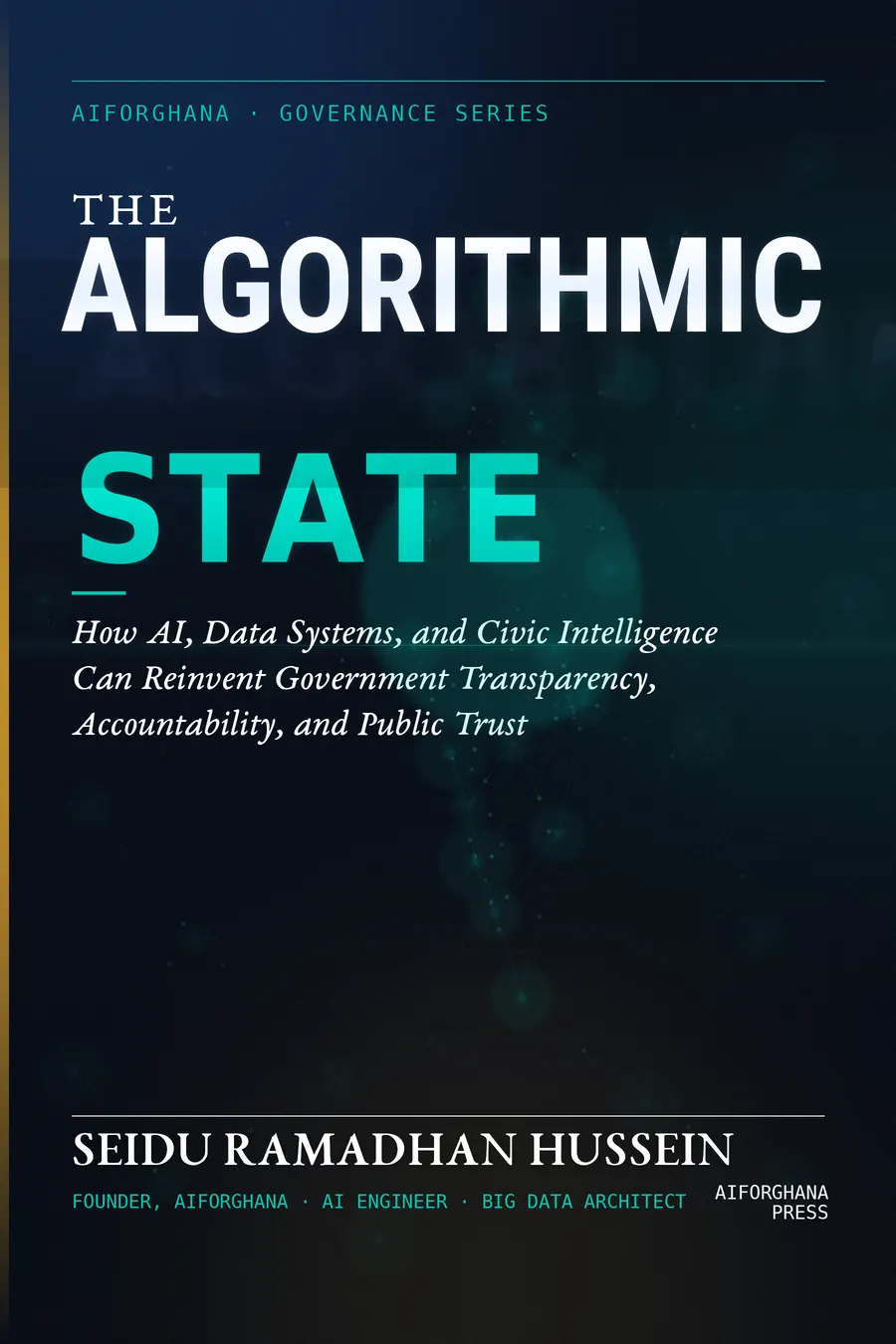
How AI Can Make Governments Transparent, Accountable, and Worthy of Trust
What if citizens didn't have to hope their government was working — they could simply see it working, in real time? This book is the blueprint for building that state.
Citizen confidence in government institutions is declining everywhere. Transparency technology is no longer optional — it is a democratic imperative.
Every nation is scrambling to adopt AI, but almost none have frameworks for making AI in government auditable, ethical, and citizen-facing.
African nations, unburdened by legacy infrastructure, have a unique opportunity to leapfrog into digital-native governance — and Ghana is proving it.
"A government that agrees to run a Control Room has agreed to be held accountable. A government that refuses one has told you everything you need to know."
— Seidu Ramadhan Hussein, The Algorithmic State
Governments today run on manual bureaucracy, slow paper reports, opaque procurement, and data silos that citizens cannot see into. Trust in public institutions is at historic lows globally — not because governments lack resources, but because they lack visibility.
The Algorithmic State proposes a radical but practical rethinking: what if the solution to the governance crisis is not political — it is architectural? Drawing on the author's direct experience building civic intelligence systems across Ghana, this book constructs the full framework for a transparent, AI-powered state.
It is the only book that moves from first principles through to production-grade implementation: from the philosophy of what a transparent government owes its citizens, to the exact technical architecture that makes it possible.
Real-time data systems that connect government spending to citizen outcomes.
Open architecture — procurement, budgets, and SLAs visible by default.
Feedback loops that make every citizen a sensor in the governance network.
Auditable AI — every government decision explained, traceable, and challengeable.
Data infrastructure owned by the state, not by cloud vendors or foreign platforms.
The most powerful single idea in this book: every ministry should operate a real-time performance dashboard — visible to the public, audited by algorithm, and impossible to falsify. This reframes the entire governance conversation. Instead of arguing about whether government is corrupt or inefficient in the abstract, the Control Room makes performance objectively visible. It connects the author's dashboard work — Civic Meter, Civic Pulse, Sɛɛ Ghana — directly to a scalable, internationally applicable framework.
There is a dataset I have looked at many times. I looked at it the first time in Accra, on an ordinary afternoon, when I was building the early infrastructure of what would become AIforGhana. The data concerned a district in the northern part of Ghana — a region with measurable increases in public infrastructure spending over a five-year period. Roads were being built. Clinics were being funded. Schools were being constructed, at least on paper. By any metric the government used to evaluate its own performance, progress was being made.
But the same dataset, cross-referenced with health outcomes and school attendance figures from the same district and the same years, told a different story. Child health indicators were declining. School attendance among girls in the district's rural communities was falling. The infrastructure spending and the human outcomes were moving in opposite directions — and no one in any relevant ministry appeared to know.
I do not say this to accuse. I say it because I went and asked. I found a district official — a capable man, genuinely committed to his work — and I showed him what I had found. He studied the data for a long moment. Then he said something that has stayed with me ever since: he said he had never seen these two datasets next to each other. His ministry and the health ministry did not share data. They never had. There was no system that connected them, no protocol that required it, and no one whose job it was to notice the gap.
I left that meeting with a question I could not stop asking: if I could see this pattern from a laptop in Accra — a technologist with access to publicly available datasets and some statistical training — why could the ministry responsible for that district not see it from their own offices? What was the name for the gap between what a government spends and what it knows?
Join policymakers, engineers, and governance reformers waiting for the book that changes how we think about government and AI.
Or reach out directly — seidu@aiforghana.org